
This week, GDR Strategy Director Sandra Perriot explores the potential of artificial intelligence for retail. From creativity on demand to personalisation at scale, she brings together a comprehensive overview of the possibilities of machine learning for retailers and brands looking to take the next step. Happy reading, and as always, feel free to contact us to discuss your AI possibilities.
Move along crypto and metaverse, Generative AI is taking centre stage.
Prepare to witness a seismic shift in the retail landscape as GPT-4, Bard, Dall-E, Stable Diffusion and other generative AI technologies begin to reshape the industry.
As retailers race to capitalise on the transformative potential of these advanced AI systems, they are rewriting the rules of customer engagement, operational efficiency and personalised experiences. Let’s step into the world of AI-driven commerce, where imagination meets technology.
Astounding growth rate.
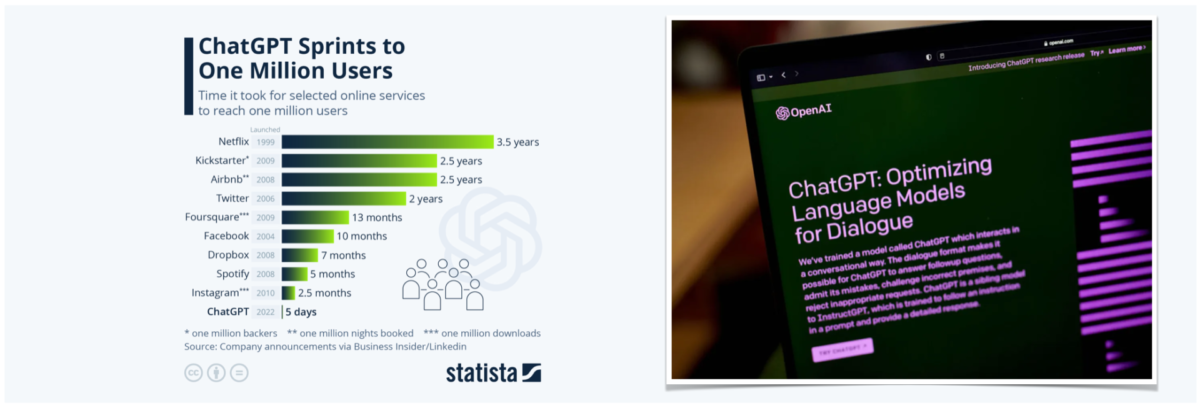
Within five days of launch, ChatGPT reached one million users and as I write, the platform reaches 100 million users and generates 1.8 billion visits per month (1). A launch like this is almost unheard of in the tech industry.
So, what can we make of the incredibly fast adoption of ChatGPT? I take away two things:
One — There is a HUGE demand for more efficient ways of working and get faster responses. Since we’ve built a performance-driven society, people and businesses eagerly await the providential tool that will super-power them.
Two — Generative artificial intelligence has a VAST range of potential applications.
What if Generative AI could make a retailer’s dreams come true?
What if generative artificial intelligence (GAI) was a miraculous tool that could “save” retail by reducing the costs of operations, creating more surprising, efficient and personalised shopping experiences for customers, while bringing agility and speed to otherwise cumbersome processes?
1. Instant/Infinite Creativity
The new technology has shown remarkable capabilities in leveraging deep learning algorithms and neural networks to create high quality visuals.
Midjourney and Dall-E learn from billions of pictures of retail spaces to come up with truly unique (so they say) and creative designs. The algorithms look at patterns, colours, shapes and their meaning in a minute. Well-used, GAI could enable us to rapidly explore and generate new design ideas, visual merchandising concepts or even entire store experience designs.
I’ve certainly enjoyed the radicality of the GAI design concepts regularly popping up on my TikTok, Instagram and LinkedIn feeds. This includes projects like “Nike on Mars” or “Imagined Jacquemus” by early GAI adopters Benjamin Benichou and Nicolas Patrouillault, created by their own initiative and for personal use only. These experiments are “intended as inspirational projects, pushing the boundaries of retail experience and user experience,” says Patrouillault.

AI generated Nike store design concept on Mars imagined by Benjamin Benichou on Midjourney.

AI-generated Jacquemus store design concepts imagined by Nicolas Patrouillault on Midjourney.
The designs are brave and bold, not necessarily realistic just yet, but sometimes that’s all we need to trigger conversations with clients and push the creative boundaries.
These mesmerising tools could accelerate the overall design process (let’s face it, we’re all visual) by allowing us to quickly test, build and iterate on ideas to create innovative and tailored customer experiences. Of course, to get the best results from silicon-based intelligence, we must learn how to properly and precisely ‘prompt’ it. Not the easiest task…
Midjourney (and other similar tools) can also be a fantastic tool to improve your ‘foot-in-the-door’ strategy. Eric Groza, international creative director, went viral on LinkedIn when he used the tool to imagine collaborations between top brands such as IKEA x Patagonia, or British Airways and the luxury fashion house Burberry. Have the brands got in touch yet? Time will tell.

AI-generated Ikea x Patagonia collaboration imagined by Eric Groza

AI-generated British Airways x Burberry collaboration imagined by Eric Groza
Marketing holds some of the most exciting applications for generative AI in retail.
GAI platforms can create images, videos, audio and text. And if you ever get stuck finding the right words for your sales pitch, ChatGPT can be a great help.
E-commerce platform Shopify has announced a feature that will allow merchants to create product descriptions using GAI. By inputting just a handful of keywords, Shopify Magic creates high quality product descriptions that fit in with a brand’s tone of voice.

Shopify Magic text generation was launched on April 2023.
Retailers can also use GAI to generate entirely new product concepts, 100% tailored to the needs of customers. Chinese premium ice cream maker Zhong Xue Gao experiments with this idea with the launch of its new product range SA’SAA — short for ‘satisfy and surprise any adventure’.
From taste, to shape, to key visuals and marketing copy, the brand claims everything from this range of products has been generated by ChatGPT – and its Chinese equivalent ERNIE – to meet customers’ expectations.

Sa’Saa China’s first AI-designed ice cream debuted in March 2023.
Previously criticised for the high retail price of its $10 ice cream, the brand has successfully leveraged AI to launch this new range for less than $1, using GAI tools to reduce R&D and marketing costs. Fun fact: On 29 March, the hashtag “Zhong Xue Gao introduces ice cream priced at 3.5 RMB” reached the top trending topics on Weibo (China’s Twitter-like social platform), receiving more than 230 million views! A great example of GAI helping to rekindle a lost audience, perhaps?
There are a lot of questions about how China’s massive and heavily censored output might impact AI-generated content on a global level, particularly in the Chinese language, since it has the largest number of internet users and the largest number of Chinese speakers. Will AI tools trained on the full constellation of Chinese-language content show implicit bias in favour of the CCP? Will state censorship limits the development of Chinese AI capabilities?
2. Waste not, want not.
At GDR, we’ve been talking about “the end of abundance” since the beginning of the year. In a nutshell, it refers to the idea that the world is entering a new era of scarcity of resources, whether it is food, water, energy, rare metals, forests or even talent (as we can see in the UK).
Misusing resources is no longer an option for businesses, and every effort should be made to reduce waste and increase efficiency in operations. GAI offers valuable capabilities for retailers to streamline and optimise processes and activities.
Here’s how GAI can help (by ChatGPT itself and me. Teamwork is dreamwork):
- Demand forecasting: GAI can predict customer demand more precisely by analysing historical sales data, market trends, weather conditions and calendar events. This helps retailers avoid overstocking and overbooking staff.
- Inventory management: GAI can optimise inventory levels by considering factors such as sales patterns, lead times and seasonal variations. This helps retailers reduce waste and improve profitability.
- Supply chain optimisation: GAI can improve logistics and reduce mishandling of goods by identifying inefficiencies in transportation routes, delivery schedules and warehouse operations.
- Quality control and defect detection: GAI can assist in quality control processes by analysing visual data or sensor inputs to identify defects or anomalies in products during manufacturing or before they reach customers. This helps retailers improve product quality and reduce customer returns.
- Sustainable product design: GAI can aid in reaching sustainability goals by considering environmental factors such as resource availability and regulation constraints from the product design level and throughout the product lifecycle. This helps retailers reduce their need for natural resources (and by doing so reducing their environmental impact).
- Labour management: GAI can be used to optimise employee scheduling, which can help to improve employee satisfaction and productivity. It can be used to automate tasks such as timekeeping, payroll and benefits administration. It can be used to create personalised training content for each employee, based on their individual skills and experience.
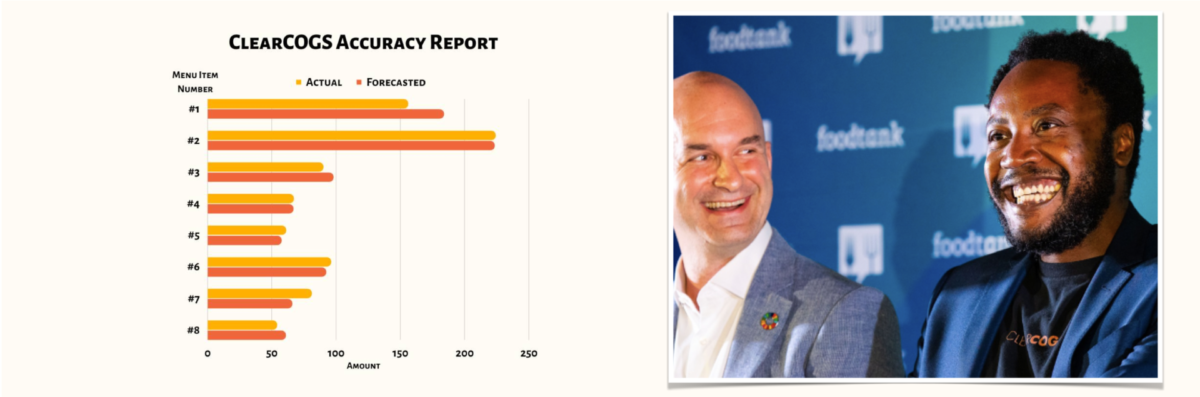
Leading GAI initiatives that ensure resilience, efficiency and profitability in operations will be business-critical for decades to come. And retailers will be able to count on start-ups like ClearCogs, a predictive operations management platform for hospitality, which invested in Generative AI to improve hotels’ and restaurants’ operational efficiency.
Using a ChatGPT engine that factors in first- and third-party data, the tool forecasts customer demand, manages inventory and schedules labour. The company recently published an accuracy report and it’s promising.
In recognition of its innovative work, ClearCogs was awarded the Waste360 40 Under 40 award in February 2023.
AI Purchasing
Walmart Inc. is leaning on AI for a more pragmatic retail purpose that will make buyers around the world nervous: bargaining with suppliers.
Leveraging an AI solution designed by Pactum AI Inc. (California), the retail giant is experimenting by handing over their vendor purchasing negotiations to a chatbot powered by generative AI. Walmart provides its budget, commercial goals and priorities to the AI solution. The chatbot then negotiates with human vendors to close the deal.

Illustration: Axel Pfaender for Bloomberg Businessweek
In a recent news release, Pactum added that its intelligent chatbot was able to negotiate contracts with up to 2,000 suppliers simultaneously, “something no human buyer can do”.
Scary? Or a brilliant initiative? Interestingly, most suppliers participating in the trial – three out of four – said that they actually preferred dealing with the robot more than a Walmart negotiator (source via Bloomberg).
From the many Chief Technology Officers I have worked with since starting in retail some moons ago, the words “personalisation at scale” have always struck me as the holy grail. And the truth is, it is. Being able to provide truly personalised products, offers and recommendations to customers based on their purchase history, their browsing behaviour and their evolving preferences is surely a recipe for success.
Over the last decade, we’ve seen many landmark retailers going bust. Most of them were sadly offering irrelevant products, at irrelevant prices, at irrelevant times. GAI could play a crucial role in keeping customers engaged by leveraging the astronomical amount of data collected from customers.
According to Forbes, only 0.5% of customer data was ever used in the pre-generative AI era. What would happen if we started using 100% of the data we’ve got? What if all the collected data were used to generate personalised product recommendations, implement relevant dynamic pricing strategies, and power chatbots and virtual assistants to remember each individual past conversations and anticipate future problems? Although we’re not there yet, pioneering retailers have already started taking interesting steps.

Expedia has been an early adopter of generative AI
The online travel agency Expedia has added ChatGPT to its app to help users better plan their trips. The intelligent chatbot is able to provide recommendations on destinations, accommodations, activities and attractions. With just a few details about users’ interests and budget, it can create an individualised list of suggestions, along with answers to questions about destinations, such as when to visit, which attractions are most popular, and how much it costs.
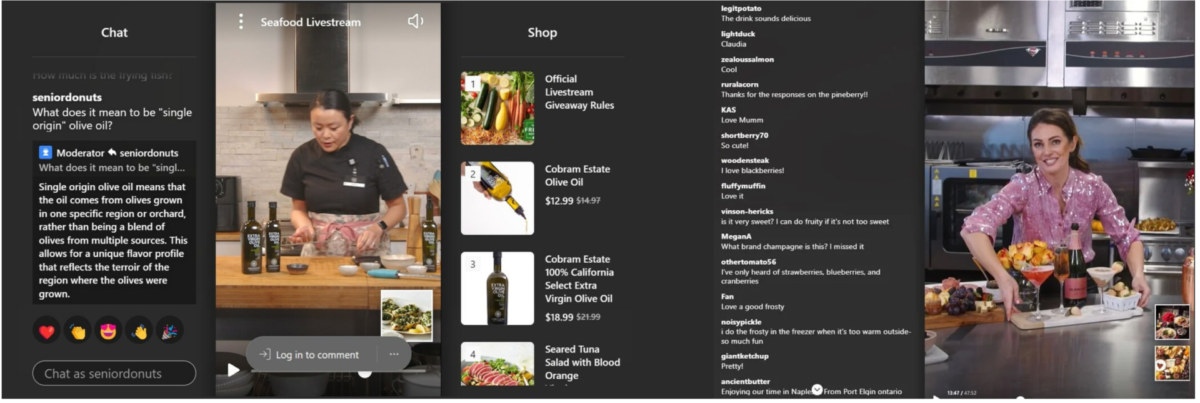
Another example of AI at work: the video commerce platform Firework has launched a “ground-breaking generative AI live shopping solution” that will enable customers to engage with in-video chat features at their convenience, notably after the live stream concludes. The patent-pending protected technology leverages user input, video content and associated metadata to deliver accurate and real-time responses to any customer’s question. Moreover, it can comprehend and interact in multiple languages while being fully customisable to align with each brand’s distinct voice.
The “first-ever Generative AI product for video commerce” was launched earlier this year, in March.
Fresh Market is a US supermarket chain and speciality grocer set to get hands-on with Firework’s first AI tool very soon. According to Kevin Miller, the retailer’s chief marketing officer, its “customers are looking to engage with [the] brand in real-time, both online and in-store. With Firework’s generative AI technology, we can be certain that customers will receive prompt, friendly and personalised support whenever they choose to engage with our video commerce content.”
Right product. Right time.
Instacart will soon launch a new conversational shopper-friendly recipe plugin on its platform dubbed “Ask Instacart”. The ChatGPT plugin will allow users to ask questions about groceries, receive personalised recommendations, and easily build their customised shopping basket on the go. It will use the chatbot to power a new search engine designed to respond to users’ food-related questions, such as asking for recipe ideas and ingredients, or healthy meal options.
Right product. Right time. Right place.

The brand started to roll out the Instacart plugin for ChatGPT in March 2023 as well.
One interesting detail in Instacart’s announcement was the mention of the guardrails that its team has built into the plugin. The retailer posted: “At Instacart, we know that large language model technology is still in its early stages, so our ChatGPT plugin is a custom, constrained tool that will be triggered only in response to relevant food-related ChatGPT questions, and people won’t be able to use it for non-recipe related tasks.”
The retailer wants to make sure that its plugin is only used for food-related content. A smart move.
ChatGPT is still ‘a bit’ unpredictable, and there is always a chance that someone could ask it to generate something off-brand or off-topic. To minimise this risk, it is important to set up clear guidelines regarding the topics and brand messages that can be used when generating content. Additionally, putting a system in place to monitor the output of the chatbot to ensure it is staying on-brand and on-topic should also be a priority.
The time is ripe for experimentation – with caution.
GAI is set to empower retailers to forge stronger connections with customers, drive engagement and ultimately boost customer satisfaction and loyalty. But, if the tool is impressive, it’s important to highlight that the technology is still under development. Its capabilities are not without flaws, so safeguards should be put in place to prevent errors as well as misuse.
Too much AI. Too fast?
In April 2023, a group of AI researchers and ethicists published “Pause AI” an open letter calling on the industry to pause the development of generative AI for six months. The letter argued that generative AI is too powerful and too dangerous to be released into the world without careful consideration.
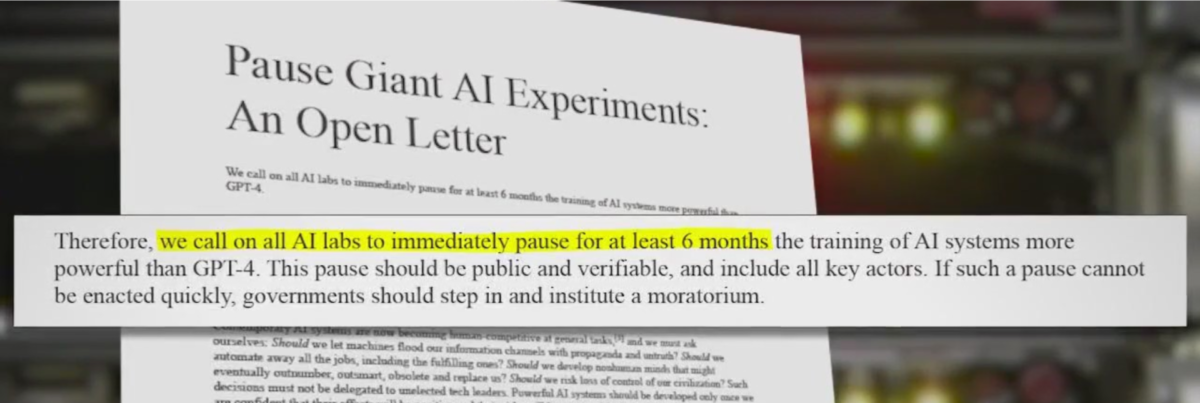
The online letter demanding a temporary artificial intelligence moratorium was published online on 29 March.
While we can still debate the real purpose of this open letter, the truth of the matter is that GAI, like AI in general, is a rapidly developing field with the potential to revolutionise many aspects of retail, our work and our lives. However, it also comes with some real-life risks that I couldn’t miss mentioning in this blog post.
Artificial intelligence pioneers have been very open about their fears lately. “We need a wake-up call. We have a perfect storm of corporate irresponsibility, widespread adoption, lack of regulation and a huge level of unknown,” says Gary Marcus, founder of Geometric Intelligence for Squawk on the Street.

Gary Marcus testifying before US Congress along with ChatGPT boss, Sam Altman.
Two of the most critical are Privacy and Cultural bias. While “deepfakes” pose a threat to privacy by potentially spreading misinformation or damaging reputations, cultural bias ingrained in the algorithms could lead to the creation of content that is harmful or offensive to certain groups of people. And currently, there are no regulations in place to address these fundamental challenges in the development of GAI.
Note: while passionate conversations are going strong across the globe, France is getting one step ahead in terms of regulation. The Commission Nationale de l’Informatique et des Libertés (aka CNIL, an independent administrative regulatory body whose mission is to ensure that data privacy law is applied) has just opened a new bureau to strengthen its expertise on AI systems to prepare for the necessary implementation of European regulations on AI.
Copyright Infringement and Accountability come third and fourth. Since GAI is being trained on existing content, what is “inspiration” and what is “stealing”? Who is responsible for the content that is created by GAI?
As you would expect, I wrote this blog in tandem with Bard and ChatGPT. Apologies in advance if I got too inspired by its words, I’m still learning how to prompt 🙂
Another issue that few are talking about is the risk of over-reliance (if not laziness).
ChatGPT and the like are powerful tools that can be used to declutter, speed up and automate a variety of tasks, however, it is important to be aware that it can also lead to a decrease in creativity and innovation, as human talents (the prompters) no longer think for themselves. Talents may become less engaged in their work, as they are no longer intellectually challenged.
In my opinion, GAI should be used to mitigate complex problems and reach excellence in retail. It should be used to empower retail professionals, not to replace them or their brains. Finding the right balance will be tricky.
Road to revolution
From streamlining operations and efficiency to reaching unheard of levels of personalisation and enhancing customer engagement, GAI is opening a world of possibilities for retailers.
After a chaotic decade in retail, we are once again able to look at the future with excitement and fascination. It’s time to go on new adventures, increase our curiosity and unleash the potential of AI technology for extraordinary customer experiences – with caution, ethics and the planet in mind.
Increasingly, industry experts are talking about “trusted AI”. They are not talking about “real” AI we can trust, as opposed to fake AI designed for PR stunts. They are talking about a “good” AI that embodies the principles of reliability, accountability, transparency, sustainability and alignment with human values. This is an AI we should all participate in building. The one-billion dollar question is: what are the values to follow?
I’ll leave that for another blog post.
Thank you for reading.
Get in touch with Rachel Wilkinson if you want to explore with us the potential of Generative AI for your business:
To go further: